UX / UI Case Study
Designed and built end-to-end — the portfolio itself is the case study.
"If I can't show client work, I'll demonstrate value by building the product itself."
This is a live case study documenting how I designed and built this portfolio. You can interact with it directly and give real-time feedback — helping shape my growth while experiencing my UX thinking first-hand.
The UX industry is crowded — especially for juniors fresh out of study. Most roles prefer prior experience, so I needed a way to stand out without relying on past client work. My approach: reimagine the portfolio itself as a live UX case study with interactive surveys and feedback loops for hiring managers.
The UX industry is crowded — especially for juniors. Most roles prefer prior experience, so I needed a way to stand out without relying on past client work.
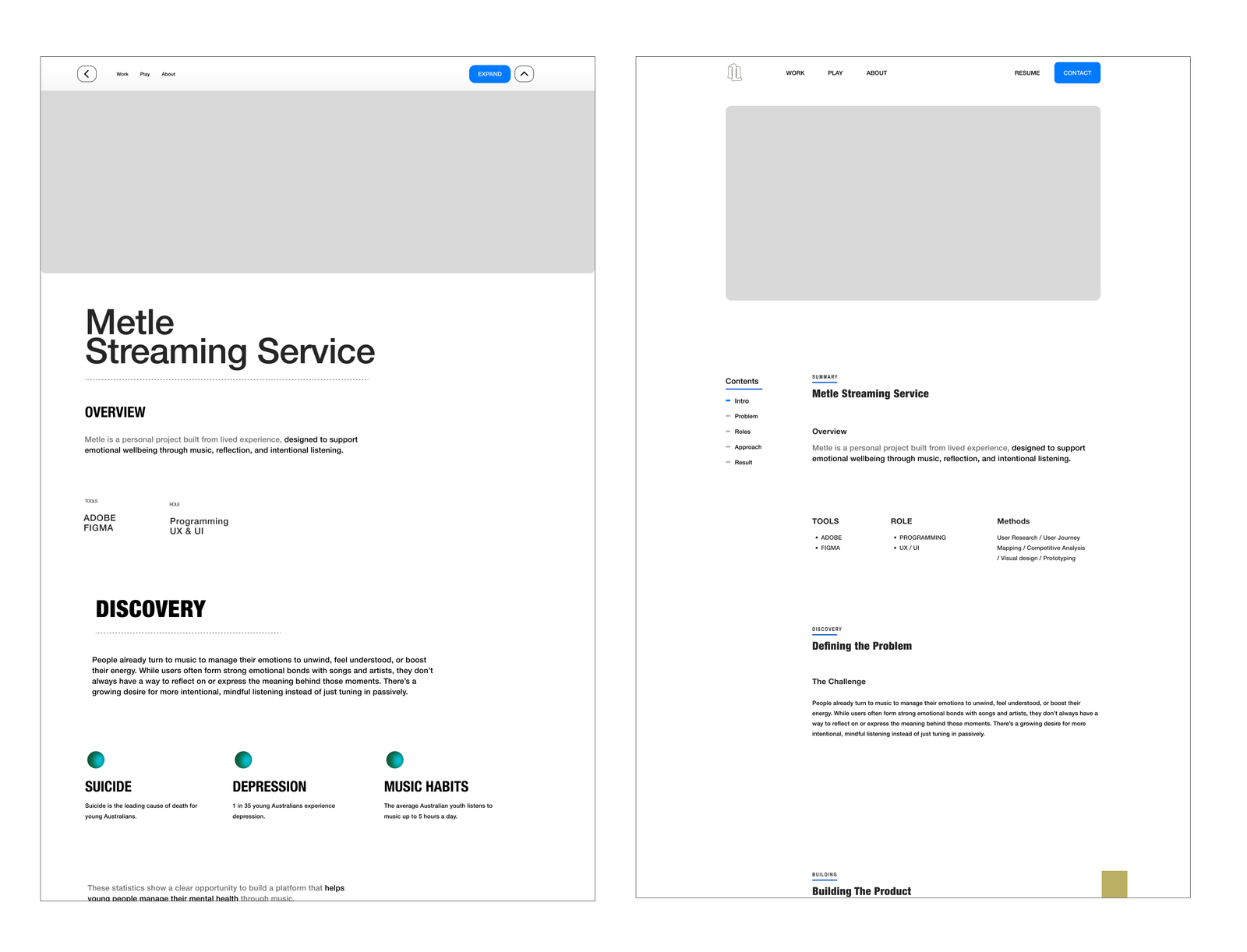
To explore different ways of structuring the case study layout, I experimented with two wireframe directions before committing to visuals.
I initially tried a full-page section scroller where each panel filled the viewport. It looked polished, but it forced a linear reading path and made it harder to scan or jump. It felt designer-driven rather than user-centred — so I cut it.
The Extended Content toggle lets the reader control depth on demand. Turning it on reveals additional process notes and artifacts with a subtle typing effect. Toggle anytime — no reloads, no interruptions.
An embedded survey system turns every visit into a feedback loop. Quick polls and free-text inputs generate real-time signal on what's working, what's unclear, and what to iterate next. Each response is stored via Firebase with a timestamp, question key, and the user's response.
This portfolio is a live case study and will continue to evolve. Every interaction and piece of feedback contributes to the next iteration.
The goal isn't just to refine the portfolio — it's to refine my practice as a designer who listens, learns, and creates with purpose.
The biggest challenge wasn't the design — it was resisting the urge to add more. Every feature I cut made the portfolio better. Removing 3D animations, auto-scroll, and heavy transitions all improved the experience by getting out of the way.
Building the backend myself — Firebase for survey responses, module-based JS, and a content JSON that drives the home page dynamically — gave me a deep appreciation for how design decisions translate into technical ones. That context makes me a better designer.
More Work